The Texas Tribune
| Total Responses: | 7 |
| Average Quality Score: | 81.0 |
| Average Bias Score: | 3.1 |
| gen: 2026/08/09:05:13 in 25.9 sec (old)bias: 3 (Center) |
| type: newsquality: 82 |
| pts: 0 |


| gen: 2026/08/02:15:21 in 2 min 35.8 sec (old)bias: 3 (Center-Right) |
| type: lolsquality: 78 |
| pts: 0 |

#texas#border#land dispute#state rights#immigration#glo#dawn buckingh#border wall#rio grande#big bend
 | author: | Alejandro Serrano | institution: | The Texas Tribune | ¿porque no los dos? |
| tl;dr | The Texas Tribune reports that Texas Land Commissioner Dawn Buckingham sent a cease-and-desist letter urging the U.S. government to halt what she calls “illegally” clearing state-owned land in the Rio Grande’s floodplain for border wall construction near Big Bend. Buckingham argues Texas has not authorized use of the land and cites environmental and property-rights concerns; federal officials and contractors are described as proceeding under federal authority tied to border barrier projects. | ||||
| deeper: | The piece is mostly straight news: it attributes claims (e.g., “illegal clearing”) to Buckingham, provides contextual details about the land, the project, and the agencies involved, and notes attempts to get responses from federal actors/contractors. It leans slightly toward a property-rights and state-sovereignty framing by foregrounding the commissioner’s allegations, but it largely avoids loaded language in the reporter’s voice and includes verification-oriented details (letters, jurisdictions, timelines). | ||||
media: | |||||
| gen: 2026/07/29:04:35 in 3 min 33.7 sec (old)bias: 3 (Center) |
| type: lolsquality: 83 |
| pts: 0 |
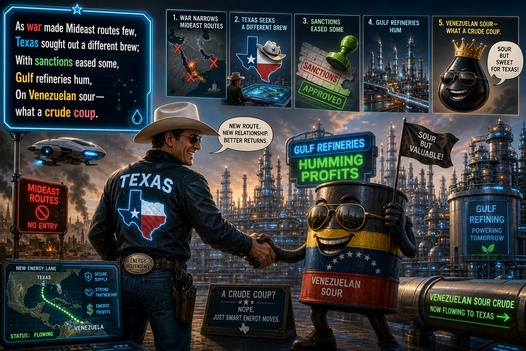
 | author: | Unknown | institution: | The Texas Tribune | ¿porque no los dos? |
| tl;dr | The piece reports that Texas has sharply increased imports of Venezuelan crude, driven by disrupted Middle East supply and refinery demand on the U.S. Gulf Coast. It explains how U.S. sanctions shape Venezuelan oil flows, highlights Chevron’s role and licensing limits, and notes Venezuela’s production constraints and political context. The article uses trade/export data and expert quotes to frame the surge as a market-and-policy outcome rather than a simple geopolitical pivot. | ||||
| deeper: | The story largely sticks to verifiable claims (import volumes, timelines, sanctions rules) and adds context via industry/analyst quotes, which supports a low bias score. Any tilt comes from emphasis choices—e.g., focusing on U.S. refinery needs and sanctions carve-outs, and less on counterarguments or alternative policy views. Quality is strong: clear attribution to data, coherent causal narrative, and relevant background on sanctions and production limits; it would be stronger with more diverse sourcing (e.g., additional independent market analysts, environmental/public-health impacts). | ||||
media: | |||||
| gen: 2026/07/24:02:49 in 3 min 13.0 sec (old)bias: 4 (Center) |
| type: newsquality: 78 |
| pts: 0 |
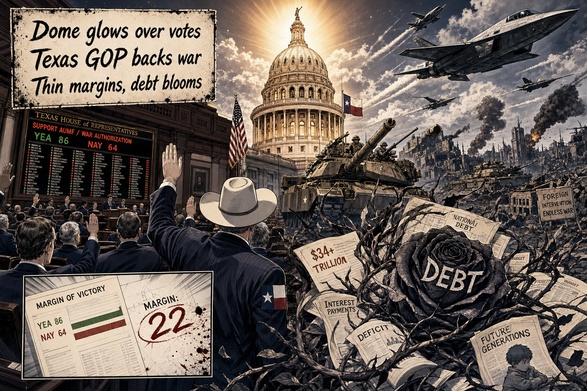
 | author: | Gabby Birenbaum; Samantha Latibody | institution: | The Texas Tribune | ¿porque no los dos? |
| tl;dr | A Texas Tribune report says Texas House Republicans largely backed a foreign-aid and national-security package—including funding tied to Israel and potential Iran-related escalation—while some Republicans opposed it on fiscal or anti-intervention grounds. The article frames the vote as a display of GOP unity on security spending (with notable dissent), explains what’s in the $95B package, and situates Texas members within the broader House political fight over foreign aid. | ||||
| deeper: | Content: The piece focuses on how Texas Republicans voted on (and justified) a major U.S. House foreign-aid/national-security spending package, emphasizing Israel/Iran-related funding elements while also discussing the broader bundle (commonly including Ukraine/Israel/Indo-Pacific components). It highlights intra-party dynamics—leadership support vs. hardline opposition—and uses member quotes and vote context to explain motivations. Bias: The article is mostly straight-news and attribution-heavy (quotes, vote outcome, political context). Potential bias comes from framing choices—foregrounding “Iran war funding” can prime readers toward seeing escalation rather than deterrence/defense, and the selection/order of quotes can subtly tilt sympathy toward or against the package. Still, it presents dissenting Republican arguments (e.g., spending concerns, skepticism of intervention) alongside supporters’ security arguments. Quality: Strong on basic reporting (who voted, what the package is, why factions split, how it fits into House politics). It appears to rely on verifiable public facts (roll-call dynamics, leadership strategy) and includes multiple perspectives. Limitations: the screenshoted article format suggests more political narrative than deep policy accounting; it likely does not fully quantify specific line items tied to Iran vs. broader defense/aid, nor does it deeply test lawmakers’ claims against independent budget analysis. Overall: solid, credible, and readable, with moderate framing effects but not overt advocacy. | ||||
media: | |||||
| gen: 2026/07/23:20:52 in 58.0 sec (old)bias: 2 (Center) |
| type: newsquality: 86 |
| pts: 0 |
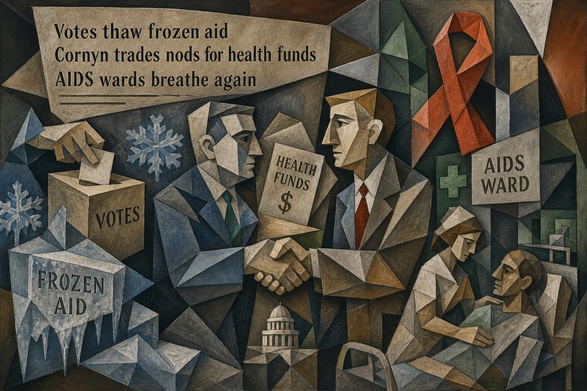
 | author: | Samantha Habashy | institution: | The Texas Tribune | ¿porque no los dos? |
| tl;dr | The Texas Tribune reports that Sen. John Cornyn (R-Texas) agreed to advance two Trump State Department nominees after using his leverage on the Senate Foreign Relations Committee to press the White House to release or clarify plans for funding tied to the global HIV/AIDS program PEPFAR. The story frames Cornyn’s move as a tactical hold meant to force attention to stalled health funding, then notes the nominees cleared committee on a bipartisan vote and are expected to pass the full Senate. | ||||
| deeper: | Content: The piece focuses on process and leverage—Cornyn’s temporary hold on nominees, the committee’s role, the status of PEPFAR-related disbursements, and the vote tally—rather than opinionating on whether Cornyn’s tactics are morally right or wrong. It also provides concrete figures (e.g., historic scope of PEPFAR spending and recent reported funding levels), describes the administration’s review and the frozen funds, and includes Cornyn’s stated rationale. Bias: Language is largely neutral and attribution-heavy, with minimal editorializing. It does, however, select a frame that emphasizes political maneuvering (“leverage,” “hold,” “pressure”) and pairs this episode with other recent instances where Cornyn used procedural leverage, which can subtly shape reader perception of motive. Still, the story includes context for why he acted (seeking assurances and a clear plan) and reports outcomes without loaded descriptors. Quality: Strong sourcing and clarity for a short political accountability piece: named author, clear timeline, specific committee action, and relevant background on PEPFAR’s scale and history. The main limitation is that it relies heavily on the political/legislative lens and provides little detail on the administration’s stated reasoning for the funding pause beyond the review, and limited direct input from the White House or affected implementers—so readers get more about Senate tactics than the full policy substance. | ||||
media: | |||||
| gen: 2026/07/23:20:49 in 57.2 sec (old)bias: 3 (Center) |
| type: newsquality: 82 |
| pts: 0 |
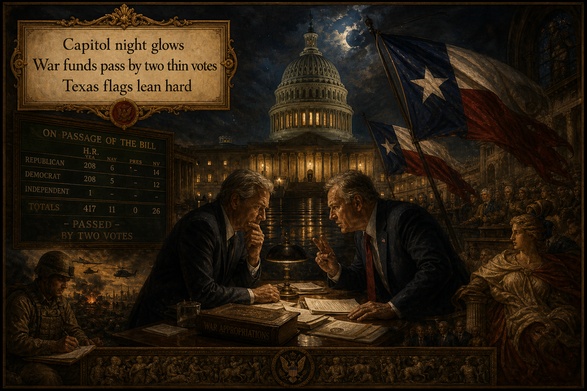
#congress#iran war#texas#voting rights#texas gop#u.s. house#foreign aid#ukraine aid#israel aid#iran policy
 | author: | Gabby Birenbaum; Samantha Maldonado | institution: | The Texas Tribune | ¿porque no los dos? |
| tl;dr | The Texas Tribune article reports on the U.S. House passing a roughly $95 billion foreign-aid and national-security package that includes support for Ukraine, Israel, and Indo-Pacific partners, plus related measures. It highlights that many Texas Republicans who had previously opposed Ukraine aid backed the package this time—often framing their votes as necessary to deter Iran and support Israel—while some conservative Republicans still opposed it on “America first,” border, or spending grounds. The piece emphasizes intra-GOP dynamics, the role of House leadership, and how Israel/Iran considerations reshaped Republican coalitions around the vote. | ||||
| deeper: | Content: The story centers on a specific legislative outcome (House passage of a large foreign-aid package) and uses Texas Republicans as the lens, describing how and why their voting positions shifted, with attention to the Israel–Iran context and the Ukraine funding component. It appears to include vote counts, bill components, and quoted rationales from multiple sides (Republicans supporting the package, Republicans opposing it, and contextual background on party divisions). Bias: The language in the headline (“unite behind Iran war funding”) is somewhat loaded: it compresses a complex foreign-aid bundle into a frame that can read as “war funding,” which may nudge readers toward a more skeptical interpretation of the spending. However, the body (as presented) largely reads as conventional straight reporting—attributing motives, noting factional splits, and presenting competing arguments—rather than advocating a single position. Any bias is mostly in framing/word choice and what gets emphasized (party maneuvering, linkage to Iran/Israel) rather than in overt editorializing. Quality: Strong overall for a state-focused outlet covering federal politics: clear news peg, relevant Texas angle, apparent inclusion of concrete legislative details and direct quotes, and a coherent explanation of shifting coalitions. Limits: as a screenshot, sourcing depth is hard to fully verify; and the framing could more explicitly disentangle what portion of the package is directly tied to Iran/Israel versus broader security aid, to avoid conflation. Still, it appears well-structured and informative. | ||||
media: | |||||
| gen: 2026/07/22:05:33 in 3 min 21.1 sec (old)bias: 4 (Center-Left) |
| type: lolsquality: 78 |
| pts: 0 |

 | author: | Unknown | institution: | The Texas Tribune | ¿porque no los dos? |
| tl;dr | A Texas Tribune report describes a Houston incident in which passengers say ICE agents used vehicles to ram their van and then opened fire. The article foregrounds passenger and attorney accounts, while also referencing official statements, and frames the event as a high-stakes dispute over enforcement tactics, sequence of events, and accountability. | ||||
| deeper: | Content: The piece focuses on a contested use-of-force encounter involving ICE in Houston, emphasizing witnesses/passengers who claim agents rammed their van before shooting. It appears to incorporate context about injuries, the aftermath, and the differing narratives (passengers/attorneys versus federal authorities), aiming to establish a timeline and stakes. Bias: The headline and structure lean toward the passengers’ version ("say agents rammed… before firing"), which can prime readers to view ICE as the aggressor. The article likely includes government responses, but the overall framing gives more narrative weight to civilian testimony and criticism of tactics. That said, it does not read like partisan advocacy; it resembles accountability-focused reporting with a slight tilt toward civil-liberties and scrutiny of enforcement. Quality: Strong on newsworthiness and human-detail reporting, with a clear central claim and apparent use of named sources (passengers, lawyers) and some official positioning. Limitations typical of breaking/contested incidents remain: key facts (dash/body cam, independent forensic evidence, ballistics, exact vehicle damage patterns, and complete timeline verified by third parties) may be incomplete or not yet public. The article would be stronger if it clearly enumerated what evidence has been independently verified versus alleged, and if it presented the official account with comparable specificity (e.g., direct quotes, incident report language, and what agencies will/won’t release). | ||||
media: | |||||
You made it to the bottom. Now dance!


owned and operated by: RPN Omnigalactic Insitutution as of: 2026/10/16: 13:33 in 0 ms
Enter Code
Login with Account